The common Model T key with the diamond shaped head was adopted by Ford in 1919. They were initially made of nickel silver until the switch was made to brass in 1926. On one side, they are marked with the Ford script and a maker’s mark like one of the following:
Briggs & Stratton
Clum Mfg.
King Lock
Caskey-Dupree
The original Ford technical drawings also list Culver Stearns as a manufacturer, but I do not recall having seen a key with that particular mark on it. The other side of the key is marked with the series number, and those numbers are 51 to 74 inclusive:
This number was also marked on the ignition switch found on the dash, a system that made stealing cars a simple task for thieves. This bit of advice was found in a 1920 issue of Motordom Magazine:
“On every ignition switch is a small number which corresponds to the number on the handle of your switch key. Organized thieves carry a complete set of these keys. A passing glance at the switch on your car gives them the number of your lock. They walk down the street, select the proper key, walk back, step in the car and drive away. A small file will in a moment or two efface the tell-tale number on the switch.“
If you are interested, the original Ford technical drawings and engineering release notes for these keys can be found in the digital collection on the Henry Ford website:
In 1920, Motordom Magazine reported on the first six-wheeled bus in America, a creation of the Goodyear Tire and Rubber Company. Resembling a trolley car, the bus was 31 feet long and seated 44 passengers. Power was supplied by a 6-cylinder Wisconsin engine which enabled speeds of only 10-12 mph. Goodyear transported around 20,000 of its Akron employees on a daily basis using 43 trucks and buses, including this one. The largest factory shift of the day, the one that occurred at 3:30, took around 40 minutes to complete.
Happy 2023! Like this bus, let’s hope it’s a . . .
This gorgeous Ford F100 with famous Twin I-beam suspension and Custom Cab package is all decked out for Christmas. It would have made a terrific gift in December of 1965 when it would have only set you back a couple thousand bucks:
You can tell that it is a ’66, not a ’65, based on the grille (the ’65 grille is just two rows of squares):
This truck’s classic good looks and red and white paint job make it the perfect truck for hauling Christmas trees. Wishing you something equally cool to haul your own trees in, as well as a very
This great National Archives photo is captioned, “Soldiers being mustered out at Camp Dix, New Jersey, 1918,” and the sheer joy captured by the photographer is palpable. Notice also the sidecar in the background, not to mention the unbelievably adorable dog.
Soldiers being mustered out at Camp Dix. New Jersey, 1918. Underwood and Underwood., 1917 – 1919 Courtesy National Archives, identifier no. 165-WW-139C(3)
Much of the automobile is obscured by the bodies of the 16 military men piled on top of it, but if you zoom in on the wheels, they do look like Dodge Brothers caps. That would make sense as the Dodges made many notable contributions to the war effort (see “More on the Dodge Brothers . . . .”). This advertisement, placed in 1918, also touches on some of their achievements:
The second paragraph mentions that the Dodge Brothers organization refrained from making any mention of its activities while the war was in progress. This tone was surely set by the Dodge brothers themselves, Horace and John, who, in addition to being brilliant machinists and manufacturers, were famously tight-lipped. One 1916 Fort Worth Star-Telegram story, “Dodge Brothers Hide Personality Behind Their Car,” reported that getting information from the Dodges was a hopeless task:
Horace positively will not talk. He refers everything to John. And John says, “The public is not interested in us but in what we make. Write about the car if you want to write about something.”
Imagine a time when people just kept their yaps shut.
The Detroit-Windsor Tunnel is a mile-long tunnel that connects Detroit, Michigan, and Windsor, Ontario. According to the tunnel’s official website, it is the only existing subaqueous international automobile border crossing in the world and is made up of 80,000 cubic yards of concrete and 750 tons of reinforced steel. It also contains 574 lights so that drivers can safely make their way through this tube located 75 feet below the surface of the Detroit River. The tunnel was officially dedicated on November 1, 1930. Many current sources report that a 1929 Studebaker was the first car through the tunnel (here and here, for example). This is surprising, because contemporary newspaper reports were pretty emphatic that the first car through the tunnel was not a Studebaker, but a Graham:
The above photo was published in the El Paso Times, and it depicts the Graham at the international boundary with the radiator in the United States and the remainder of the car in Canada. It is easily identifiable as a Graham because of the large ventilation doors on the side of the hood that could be opened and closed separately by pressing small chromium buttons.
The Graham brothers, who had been in the truck business before selling out to Dodge Brothers, purchased the Paige-Detroit Motor Car Company in 1927. This means the Graham Eight used to christen the Detroit-Windsor Tunnel must have been brand-new, because it was called a Graham-Paige from 1928 through the first series of 1930. This shiny, new Graham would have been powered by a 100-hp L-Head Eight with 3-1/4 x 4-1/2 bore/stroke and displacement of 298.6 cubic inches. The distinctive Graham emblem is a stylized depiction of the three Graham brothers, Joseph, Robert and Ray, as knights:
The reports from 1930 do not mention why the Graham was chosen to make that first trip under the Detroit River, but perhaps it had something to do with the automobile’s “dignity and class”:
These “Safety Thoughts” were published in the June 27, 1926, issue of the Tampa Tribune and, clearly, not much has changed in the last 96 years. Keep these in mind and have a happy and safe Thanksgiving!
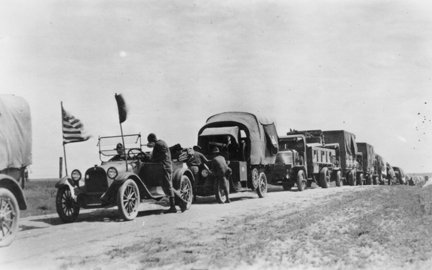
A line of Ford Model Ts at Pioneer Village in Minden, Nebraska
In 1912, the New York Herald asked well-known racers of the day what they would describe as their “most thrilling moment on the track,” and the answers given really take you back to that time and place. One of the racers who gave a response to the newspaper was Ralph De Palma, the winner of the 1915 Indianapolis 500. Here is his story:
Ralph De Palma
De Palma racing a Mercedes in the 1914 Vanderbilt Cup race
There were many different automobile companies that incorporated the name “Cleveland” into their title. One of these was the Cleveland Automobile Company, maker of the Cleveland Six and the subject of this 1926 advertisement for a Daytona Beach demonstration, which features a famous racer of the day by the name of Ralph Mulford:
Mulford was named to the Auto Racing Hall of Fame (now the Indianapolis Motor Speedway Hall of Fame) in 1954 along with Eddie Rickenbacker, putting him in very good company. During the course of his career, he racked up American Automobile Association championships and wins in the famed Vanderbilt Cup and Elgin road races. He also participated in hill climbing events and set records “climbing to the clouds” at places like Pikes Peak and Mt. Washington.
Mulford took part in the first Indianapolis 500 in 1911 as well as every Indy 500 race through the 1922 contest (there were no races in 1917 and 1918 due to World War I). He drove a Knox in the 1912 contest, and his finish that year makes for an interesting story. He was “tickled to death” with the six-cylinder Knox, but experienced engine trouble the day of the elimination trials in the form of a cracked cylinder. While the repaired motor was being reassembled in semidarkness, two springs were left out of the clutch. The slipping clutch made winning out of the question, but prize money was being paid to the top ten spots. Tenth place received $1,200, a not insignificant amount in 1912, but race officials were sticklers that Mulford had to actually finish the race in order to claim the prize.
By the time Mulford pulled into the pit for gasoline and an engine readjustment, the stands were empty and the guy in the timer stand was focusing his attention on a chicken sandwich. The starter, a man named Wagner, was the lone figure on the track and apparently could not get his hands on any chicken because he was reported to have said, “This is a farce. Mulford is taking his time and might be on the track a week. I want to eat.” Upon learning that he would need to drive through the gloom and finish the final 21 laps if he was going to get paid, Mulford and his mechanic, who was required to ride in the race car at that time, crawled back in with a box of food and some cigarettes. They alternated between munching sandwiches and smoking cancer sticks while they finished the race, and it took them a total of nearly nine hours to do so, two hours and 31 minutes behind the winner.
When Mulford passed away in 1973 at the age of 87, he was thought to be the last surviving driver of the inaugural Indy 500. He still holds the record for the slowest finish thanks to that 1912 race.
Sources:
“Aftermath at Indianapolis.” Los Angeles Sunday Times, 2 Jun 1912, p. 2-VII.
“Chandler Makes New Record on Climb to the Clouds.” Monrovia Daily News, 1 Dec 1923, p. 2.
“‘Depalma Luck’ Loses Big Race.” Indianapolis Star, 31 May 1912, p. 13.
“Famous Auto Racer is Tampa Visitor.” Tampa Tribune, 27 Jun 1926, p. 2-D.
“Famous Race Driver to Pilot Stock Car at Daytona Beach.” Cocoa Tribune, 4 Jun 1926, p.
“Four Named to Auto Racing’s Hall of Fame.” Daily Argus Leader, 23 Jan 1954, p. 3.
“Officials Recheck Speedway Racers.” Indianapolis News, 31 May 1912, p. 21.
“Ralph K. Mulford, Former Auto Racer.” Asbury Park Evening Press, 26 Oct 1973, p. 19.
“Ralph Mulford and His New Six Cylinder Knox.” Portland Sunday Telegram, 26 May 1912, p. 8.
We bought a box of radiator caps the other day, and in the bottom were not one, but two, 1929 Essex radiator caps. Back then, these distinctive, twelve-sided caps were described as “faceted in semi-modernistic design,” whatever that means.
The full name for the automobile in ’29 was “Essex the Challenger,” and it was powered by an L-head inline 6. This label was conceived, according to the Hudson/Essex organization, when test after test revealed that the Essex could match more costly cars on every count including speed, acceleration, hill climbing and gasoline consumption. Dealers who had gathered at the Detroit factory for a private demonstration were so impressed by its performance that one dealer enthusiastically proclaimed that the new Essex could challenge anything, and thus a new slogan was born.
Every dealer in the Hudson/Essex organization took part in a National Challenger Week, putting the automobiles to every conceivable test and even taking suggestions from the public as to which tests the cars would be subjected.
In Wichita, for instance, an Essex underwent a five-day continuous run on a treadmill in the Mosbacher dealership window.
In Albuquerque, an Essex was driven the 302-mile stretch to El Paso in five hours and 57 minutes with state highway police clearing the way, and in Akron, an Essex was given to a traffic cop to use in place of his motorcycle for the week. In Chattanooga they focused on hill-climbing with demonstrations given on Lookout and Signal mountains. The subject matter of the following advertisement is all the new records set by the Essex during Challenger week, including a new record for climbing California’s Mt. Baldy by covering 8.05 miles of hairpin turns in 10 minutes 16.4 seconds.
The promotion was a successful one, and enough cars were sold to make Hudson/Essex third in the industry behind only Ford and Chevrolet.
The full name for this particular piece of equipment is the Vacomat Automobile Mileage Tester, and it was manufactured by Donat A. Gauthier of Detroit. It came with quite a lot of hose, which this one is missing, that was used to by-pass the fuel pump. It held 1/10th of a gallon of fuel so that a car didn’t have to travel very far (and use much gas) in order to obtain a result. A result, incidentally, that was 99-2/3% accurate, at least according to the label:
According to the inventor’s 1988 obituary, Donat A. Gauthier was a French-Canadian engineer who relocated to Detroit as a young man in search of employment. He ended up staying for 63 years, during which time he worked as a consultant to automobile companies, served as a French consular official, and founded his own company to manufacturer this device to test gas mileage. This is a photo of Gauthier from 1950:
In 1958, the Vacomat was utilized in a Ford dealer’s weekly contest. To participate in the contest, entrants simply took a Ford for a test drive. The Ford was equipped with a Vacomat, and the driver achieving the best miles per gallon won fifty gallons of gas:
The Vacomat surfaced again when gas prices began going up in the 1970s. In this 1973 advertisement, the tester was used to determine the mpg capability of the automobiles on the lot:
A hundred gallons of gas was offered as a very nice reward for purchasing one of this dealer’s cars, but that would only take you about 680 miles if your automobile of choice was that ’69 Lincoln Continental.