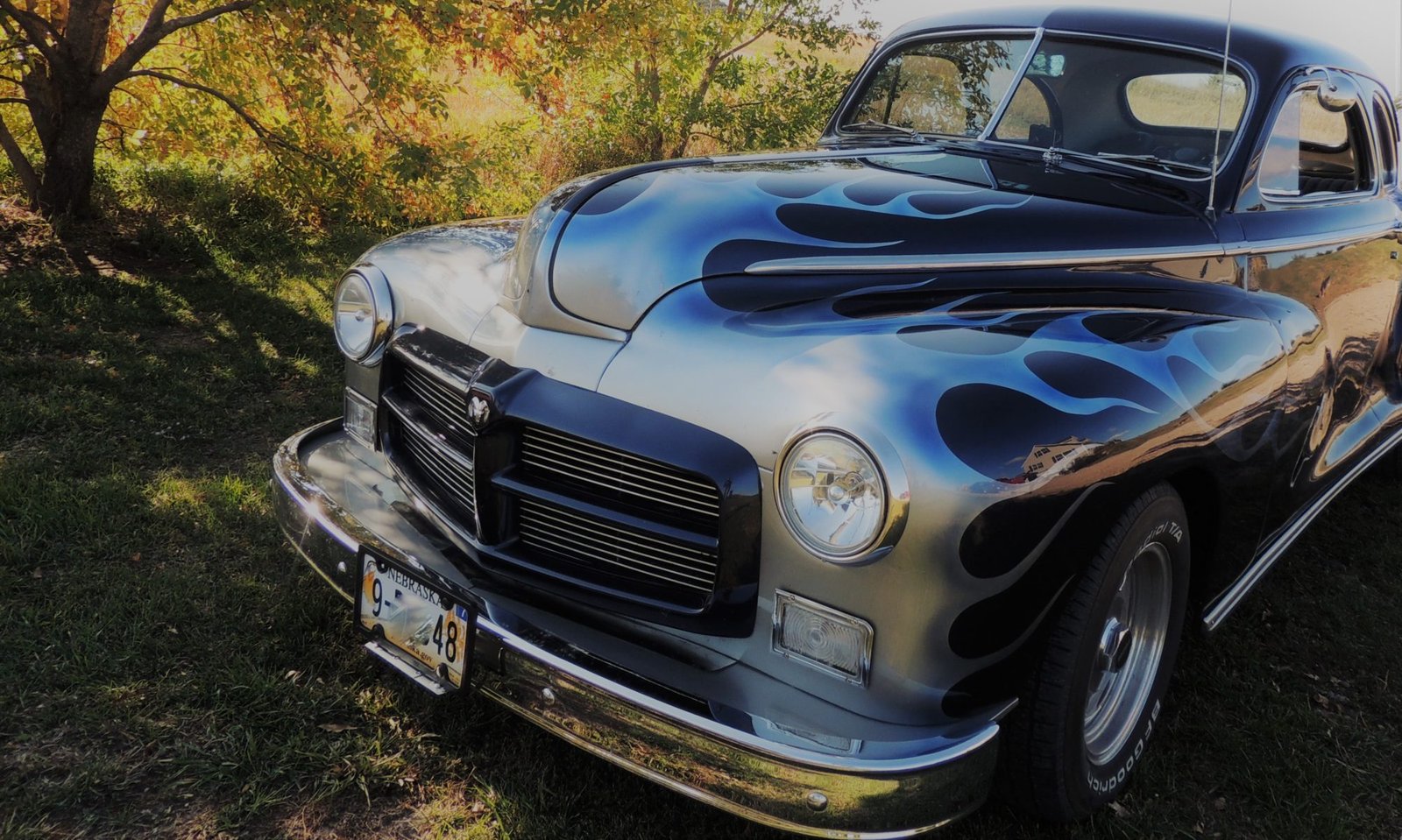
Like the 1968 Mustang featured in the Steve McQueen flick “Bullitt”, my very first car was a ’68 Mustang. Unfortunately, it was a coupe, not a fastback, and sadly had a straight-6, not a 390. It was also full of Bondo, but I loved it and do wish I had it back!
It was all over the news this week that the Mustang featured in the Steve McQueen movie “Bullitt” sold for a whopping $3.74 million at Mecum Kissimmee.
The Highland Green 1968 Mustang GT has a 390 under the hood and roared beautifully during the famous chase scene that reached speeds of 110 to 114 mph. Car-guy Steve McQueen was actually driving while running down the black Dodge Charger. Director Peter Yates was sitting in the back seat.
This 1969 ad for the movie says “McQueen embodies his special king of aware, existential cool”. I’m not sure what “existential cool” is, but McQueen is definitely just plain old cool. The car chase is described as a “terrifying, deafening shocker”.
Abe Battat, pianist and band leader, had a small part in the movie, but apparently his Austin-Healey did not fare well during filming. This funny blurb appeared in a 1968 newspaper story:
Screenstar Steve McQueen, here shooting a film called “Bullitt”, smashed his Mustang into the side of Pianist Abe Battat’s Austin-Healey, parked at Taylor and Clay during a scene. Steve to Abe: “Warner Brothers will take care of it.” Abe, playing a bit part in the flick: “I’ll take care of it if you give me a few more lines.” Sorry.
On the subject of hubcaps, I was beyond elated to find this rare hubcap for sale in an antique store the other day.
It was shoved to the back of a bottom shelf with other (different) caps stacked in front of it, but I am so glad I kept digging to see what was back there. It is an accessory hubcap, sold by GM dealers, for a 1939 Chevrolet.
This is how it appeared in the ’39 accessory brochure. Notice that it was called a “wheel disc”, and only cost $9.90 for a set of four!
You can still read the stamp on the back of my hubcap that contains the name of the manufacturer, Lyon Inc.
Lyon was headquartered in Detroit and was a large producer of hubcaps. One newspaper story from 1957 even said that Lyon was “the world’s largest user of stainless steel”. The company made both official versions, like mine, and aftermarket caps like this one:
This is an advertisement for Lyon that appeared in 1953:
I have no idea how many “wheel discs” like my ’39 Chevy were sold, but I do know that you almost never see them. Mine has some shallow dents but is in great shape overall. What an exciting find!
Old, aftermarket hub caps keep finding me lately, and some of them are just hilarious. Inexpensive replacement caps were sold by companies like Western Auto and J.C. Whitney, but the logos had to be altered enough to avoid pesky trademark infringement laws. Some of them are pretty good facsimiles thereof, like this Cadillac replacement cap. It is heavy duty and looks like the Caddy emblem, but has lines instead of ducks:
This one has stars instead of ducks.
Frankly, they both look better than the modern Cadillac version that has been sanitized of its history and personality. For Chevy replacements, a dash was commonly used in place of the bowtie:
This one is for a 1954 Chevy, and it is a pretty good copy, too. You have to look hard to see that it is a dash and all one piece (the real ones have a separate center insert).
The really entertaining versions are the ones with altered spelling. I have seen dog dishes that say “Dodoe” instead of Dodge, for instance. The Chrysler replacement cap pictured below says something like “Clrrfrlir, although the “i” is mysteriously undotted.
This is one of the famous “Bool” caps made for a Model A Ford:
I have heard that they also made a “Fool” version. I’m not sure who would want to drive around with those on their car (but I know of a few people who should).
By the 1920s and ’30s, crime had organized and was being exacerbated by Prohibition. Law enforcement welcomed the cheap horsepower of the Ford flathead V8 in 1932, but they also needed better firepower. Most people today would be shocked by the sight of machine guns mounted on police cars, but armored and armed to the teeth was the trend for the boys in blue as they combatted the crime wave.
In the Big Apple, one 1925 newspaper story announced, “War is scheduled for the sidewalks of New York.” Forced to desperate measures by the temerity of crooks, police turned to the late World War as their model and gave each of the nine detective districts their own “arsenals on wheels”. Manned by three crews of marksmen so they could be in service 24 hours per day, each patrol car was armed with revolvers, tear bombs, machine guns, shot guns and rifles. They were also provided with rockets in case the radio set failed.
This 1930 photo shows a Dayton patrolman holding one of the two Lewis .30 caliber machine guns to be mounted on movable pivots on that department’s new patrol car. The article says the guns were capable of firing 600 rounds per minute “in short bursts or a continuous stream of death-dealing lead.” The car also featured bullet-proof glass and upholstery, but no details were given on what that pre-Kevlar upholstery was made of.
This 1930 Buick was “equipped especially for the protection of Lincoln police officers when in pursuit of bandits or other outlaws.” It had bullet-proof panels in front of the radiator, a bullet-proof hood and cowling and 1-inch thick bullet-proof windshield. Front tire guards were also going to be installed, but there was no mention of machine guns in Nebraska’s capital.
Also in 1930, the police department in Gary, Indiana purchased a new armored Hupmobile with “a gun port like an old frigate”. The Hupmobile was a great choice because it was already available in 8 cylinders and 133 horsepower in 1930. It would have been very expensive at around $2100, roughly four times the cost of a Ford. The gun port went through the right side of the windshield and was designed to accommodate “the barrels of any kind of firearm up to a riot gun.”
Anyone who has spent any time in Kansas City knows the city takes more than a little pride in its wild and woolly history, so it is no surprise that the Kansas City police department’s new armored Ford V-8 cars in ’32 had no less than three mounted machine guns, one in a bracket on the rear of the front seat and the other two under the top of the car. Bullet-proof nickel manganese steel a sixteenth of an inch thick lined the body and doors and steel flaps protected the tires from bullets. The glass was over an inch thick and weighed 14.5 pounds to the square foot.
And that’s just one more reason that I would never have made it as a criminal – I could not have fired shots at something this pretty!
This wonderful Ford advertisement was published in time for Christmas of 1936, and the Ford flathead V8, which first appeared in 1932, was also a “grand gift” for the law enforcement family. Never before had so much horsepower been so affordable. By 1934, the Ford flathead had 85 hp, and this 1934 ad claimed Ford had the only V8 under $2500. (Note that it was way under with prices starting at only $515.)
Stories about bad guys doing horrible things like robbing banks and gunning down police officers were splashed all over the front pages of newspapers, so, as one Ford rep explained, “We are answering the challenges of gangsters by giving police these speedy, powerful cars.” In 1934, New York City added 85 shiny new Fords to its fleet. The cars were lined up fender to fender outside the Ford factory at Edgewater, NJ, and they almost completely spanned the 1500-foot-long car assembly building:
San Francisco received their new fleet of Fords in 1936:
These early successes earned a solid reputation and a loyal following that made Ford the police car of choice for decades until being knocked off its pedestal (temporarily) by Mopar in 1969.
And who could possibly disagree with the sentiment expressed by that 1936 advertisement? A Ford V8 WOULD make a grand Christmas gift!
Last week I told you about Custom Rides in Hastings, Nebraska. The owner, Pat Brubaker, is doing his part to keep the metal shaping profession alive by holding classes approximately once a month. Brubaker describes the skills needed for metal shaping as ranging from finesse to controlled violence, and I don’t think these classes are for the faint of heart. Each class consists of four 12-hour days with a maximum of only four people in each class. The emphasis varies and may include basic fender repair, the use of tools (like the English wheel and power hammer) and the creation of entire body panels from flat sheets. Brubaker likes to have participants build entire bodies because something that seems initially overwhelming becomes less intimidating when taken piece by piece. Class participants leave armed with knowledge and fired up about tackling their own projects. Check out these pictures from some recent classes, and then see the Custom Rides facebook page for more information.
Harley Earl is frequently described as a pioneer, but even that term seems inadequate when talking about a man of artistry and vision who literally shaped American automotive styling. Born in 1893, Earl started out working in his father’s carriage works shop in Los Angeles. While there, he began customizing cars for movie celebrities on the side. Earl was part of the transitioning of the automotive industry from its buggy and wagon roots by bringing cars down off their high wheels and enclosing the tops. What started out as a side business quickly made the Earls the biggest builder of high-grade custom bodies in the west.
The Earls’ going concern was purchased by Don Lee in 1917 and he kept Harley Earl on as chief designer. Lee sent Earl to the eastern part of the country and also to Europe to study the trends. As one paper put it, Earl was soon making the cars designed in the east “look like something the cat dragged in.” Lee also owned a Cadillac dealership, and Earl’s skills caught the attention of Cadillac executives who gave him the task of designing the 1927 LaSalle.
At the time,
Earl said that the main advantage in designing the LaSalle was that “there was
not a tool or die waiting to be used for its manufacture. That permitted us to begin building this car
from the ground up. It placed us in a
position where we were dared to execute something distinctly different – and
that is exactly what we set out to do.” The design was heavily influenced by
the streamlined bodies of the racing industry and, interestingly, Earl called
the LaSalle distinctly “American in its lines, appearance and atmosphere.”
This idea of
American versus European design was revisited by Earl the following year. He noted that some American carmakers that
were offering “European design” were making two very big mistakes. First, they were failing to capture the more
outstanding trends in the design of European car bodies and second, they were
failing to differentiate between engineering and body design and therefore were
copying undesirable European engineering.
According to Earl, “Europe today offers nothing comparable with the
surging power, sturdy construction and roomy comfort of American motor cars,
three characteristics that seem reflections of our country’s own vastness.”
Earl knew
what he was talking about, and the new LaSalle was a hit with the public. General Motors put Earl in charge of their
new art and color section, and he remained with General Motors until his
retirement in 1958. When he died in
1969, the papers referred to an interview in which Earl had said, “My primary
purpose for years has been to lengthen and lower the American automobile, at
times in reality and always, at least, in appearance.” He is credited with
curved-glass rear windows, two-tone paint, wrap-around windshields, the first
Corvette and, best of all, tail fins.
1955 Nomad
Many of us who appreciate the old iron think that Earl’s way of thinking is sadly lacking in today’s cookie cutter auto industry, but, thankfully, the spirit of Harley Earl appears to be alive and well in custom shops scattered along the backroads of this great country. One such shop is located not far from me in Hastings, Nebraska. The shop is called Custom Rides, and the man swinging the hammer is Pat Brubaker.
My better
half and I were introduced to Brubaker by a mutual friend and spent an
afternoon at his shop. We walked away
very impressed with both the skills and the work product at Custom Rides, and
if you have a need for metal shaping or fabrication, this shop should be your
first call. Brubaker makes everything
from trim to fenders to entire car bodies and works with steel, aluminum,
stainless, copper and brass. He has found a niche making odd and unique parts
such as part of a Reo grille shroud and a Tucker trim piece for, get this,
customers in California who were disappointed in the results from some local
shops they tried in the Golden State.
Welcome to the Cornhusker State.
Brubaker
credits his racing background for his education and approach to problem
solving. He says while racing midgets
and mini-sprints, he was around smart people all the time and learned much from
them, including how to make all the odd and unique parts needed. He jokes that, in racing, when you change one
thing that means you are going to change everything but the paint color. This background has clearly served him well
because he isn’t afraid to “re-invent the wheel”, even when that wheel is an
English wheel (a metal-working tool). If
he needs to make the tools that make the tools that make the tools in order to
finish a job, that’s exactly what he does.
Some of the
projects in the shop now include this chassis for a 1950 Henry J . . .
. . . as well these dually truck fenders. The first picture shows the original that the customer wanted replicated, left and right. Brubaker started by creating an edge band and a buck for it to rest on. That is a smooth finish!
Brubaker would like people to know that the things they want are not out of reach. Whether you are looking for a rolling chassis or complete car body, this shop can produce it. He has a healthy respect for tradition but still looks for a better way to get the job done, and that is an approach that Harley Earl himself would likely approve of. If you want to see if Brubaker can assist you with your project, this is how you reach him:
This blog post is my honest and independent opinion and not sponsored in any way.
Sources:
“Big Automobile Factory and Top Factory Now Property of Cadillac Distributer Here.” Los Angeles Evening Express, 12 June 1919, p. 2.
“Designer of Cadillac and LaSalle New Bodies Visits Home Town With Other Executives.” Los Angeles Evening Express, 15 February 1928, p. 3.
“Don Lee Builds Another Special Classic.” San Francisco Chronicle, 21 November 1920, p. 4A.
“GM Stylist Harley Earl Dies.” Detroit Free Press, 11 April 1969, p. 3.
“Harley Earl, Of Car Factor in Los Angeles Home Again.” “Los Angeles Sunday Times, 15 May 1927, p. 9.
Henry, Bill. “Alumni of Auto Row.” Los Angeles Times, 30 March 1930, p. 5.
Ivory Roadster Especially For Bay City Show.” Los Angeles Times, 17 February 1924, p.13.
“Stylist Traces Auto From Whipsocket Age.” The Indianapolis Sunday Star, 28 October 1928, p. 2.
$25,000 Dazzler of Roscoe Arbuckle Makes Motorists Gasp in Amazement.” Los Angeles Evening Express, 1 May 1920, p. 7.
I have seen lots of stories scattered across the internet that claim to hold the key to the Cadillac crest, but this explanation appeared in 1923. That is only two decades after the company’s 1903 inception, so maybe this story was less distorted by time than some of the more recent versions. You make the call!