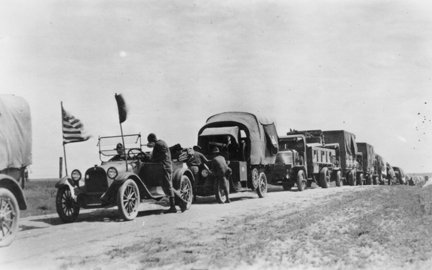
I found this photo when I was researching my last post about the 50th anniversary Ford. It appeared in a June 1953 newspaper, and the caption reads:
“Fifty years ago, when Ford Motor Company was founded, the average man would have worked 17 months to earn enough money to buy a runabout consisting of little more than a two cylinder engine and a buggy frame. Today the cost of a Ford car similar to those above is equal to the wages an average man earns in 3 1/2 months.“
So, in 1953 the “average” man could purchase a new Ford with wages earned in the span of 3 1/2 months. How does that compare to today? According to the Social Security Administration, the average annual salary for Americans in 2019 was $51,916.27. Most new Fords would take every bit of that!
1953 Ford at the Platte Valley Antique Machinery Association Show
In 1953, Ford Motor Company was celebrating the 50th anniversary of its June 16, 1903, founding. The new Fords were given restyled, massive grilles and horn ring emblems that marked the occasion.
Ford called it the “Worth More” car because of the 41 “Worth More” features that made it “worth more” when both buying and selling:
Many events were held to commemorate the occasion, including a television special and the lighting up of the famous Ford Rotunda building like a birthday cake.
At the time of that 50th anniversary celebration, 168,000 Ford workers around the world were being paid more than $17 million on a weekly basis. To show just how far the company had come, some papers printed copies of the ledger page showing payroll for Ford’s very first week of operation; in June of 1903, the company’s seven employees were paid a grand total of $85.23.
The Chandler Motor Car Company was in operation from 1913 to 1929 and touted their six-cylinder product as a light-weight car (less than 3,000 pounds) that was “built by men who know.”
Those men were largely former lieutenants of the Lozier Motor Company, no fewer than seven of the officers and department heads being formerly connected to that company.
A 1916 write-up about the Philadelphia Auto Show referenced the company’s policy of building only one type of chassis on which they would mount the different body styles. Aside from the Chandler Six motor, other equipment included an aluminum crank case, silent full-floating spiral-bevel gear rear axle, long semi-elliptic springs, front and rear, Bosch high-tension magneto, Grey & Davis separate unit electric starting and lighting system, silent chain drive for motor shafts, annular ball bearings, Stewart-Warner magnetic speedometer, Stewart vacuum gasoline feed and non-skid rear tires.
The Chandler made some headlines in 1917 thanks to the antics of a politician, a state senator by the name of “Wild Bill” Scott. I had never heard of this particular “Wild Bill”, but there was another 1917 story about him assisting an elderly woman who wanted to see the California Senate in action but couldn’t because all the chairs for spectators were full. Scott had a page bring another chair to his desk on the floor so that the lady could sit with him to watch the proceedings. After that incident, the Santa Ana Register printed this description of Scott:
“That’s ‘Wild Bill’ Scott. He’s loud-mouthed for booze and doesn’t care who knows it; he’s out-spoken, blustering and breezy and generally votes wrong on every moral issue that comes before the Senate and yet he is continually doing acts of kindness for some little friendless kid or some aged lady who seems to feel she is out of place in the legislative halls.”
In regard to Scott and the Chandler automobile, the story started when Scott and some of his fellow legislators hopped a train to Sacramento. Scott got off at one stop to send a telegraph and the train departed without him, much to the amusement of his colleagues. A Chandler Touring Car was parked in front of the station, and Scott bet the driver that he couldn’t beat the train to Sacramento. A wager was made in which Scott gave odds and the Chandler was off. The speeding driver was pulled over at Dixon, whereupon Scott stood on the rear seat and gave an impromptu patriotic oration to the town constable. It must have been a good speech because the officer sent them on their way. The Chandler and its pair of occupants arrived at the Sacramento train station a full four seconds ahead of the train carrying the other legislators. It was reported that Scott first paid the driver on the wager and then promptly sent a wire to San Francisco to purchase a shiny new Chandler for himself.
Sources:
“Chandler Car Saves Senator From Big Joke.” The San Francisco Examiner, 14 January 1917, p. 4A.
“Chandler Car Saves Wild Bill Scott From Being A Goat In Joke.” Visalia Daily Times, 20 January 1917, p. L-1.
Chandler Motor Company. Advertisement. Los Angeles Times, 30 January 1913, p. VI-12.
Chandler Motor Company. Advertisement. The Boston Globe, 20 July 1913, p. 43.
“Chandler Six May Enter Local Field.” The Tacoma Daily Ledger, 24 August 1913, p. 21.
“Convention Hall Scene Of Largest Automobile Show.” The Philadelphia Inquirer, 9 January 1916, p. 2.
“Wild Bill Scott Votes Wrong, But He Does Kind Acts.” Santa Ana Register, 9 April 1917, p. 2.
While rifling through the April 3, 1927, edition of the Los Angeles Times, I found this great photo of famed aviator and TWA President Jack Frye buying, what else, a Rickenbacker, the automobile named after WWI pilot Captain Eddie Rickenbacker, the “Ace of Aces”.
For more on the Rickenbacker and its distinctive radiator badge:
This 1959 Pontiac was a recent and welcome entry in the local car show:
When announcing the new line, Pontiac Motor Division general manager S. E. Knudsen said, “Pontiac has broken all bonds of traditional styling and engineering in 1959 with the most progressive change in our Division’s 51-year history. ” This was no exaggeration. Pontiac decision makers had left behind Indian-inspired names and ornamentation like they were a Cleveland baseball team, and Catalina, Star Chief and Bonneville comprised the ’59 line up. These models had 65 brand new features including lower, wider and heavier bodies and Vista-Panoramic windshields with greater visibility. Engine displacement was increased from 370 to 389ci with the Tempest 420 V8, and options included triple 2-barrel carburetion and Hydra-Matic transmission. Another new feature was the split grille, which Pontiac called a twin “air scoop” grille:
The new body was nearly five inches wider, and Pontiac labeled it “wide-track”:
These Pontiacs aren’t as plentiful as their Chevrolet counterparts, but their more simplistic styling makes them a beautiful alternative.
I love vintage automotive accessories, and this “Beauty-flash” is one I hadn’t seen before. It is a light-weight aftermarket hood ornament and it is very long, over 23 inches in length. The box indicates it was made by a company called Knight-Morley.
I hadn’t heard of Knight-Morley, either, and I guess that is because they weren’t around very long. In 1953, the company fired some employees that walked off the job in a dispute over safety conditions, namely heat and dust. Other employees went on strike to protest the firings, and they were let go, too. The company was accused of unfair labor practices and eventually had to pay the employees back-pay of approximately $66,000. In the meantime, however, the business was sold to C.M. Hall Lamp Co., and that business moved operations from Detroit to North Carolina.
I found this advertisement for the Beauty-flash in a 1949 newspaper:
Other items advertised alongside the Beauty-flash in this same ad include an auto desk, a man’s size ash tray and a DIY body-fender tool kit. All things you don’t see anymore!
On a Saturday morning in September, 1934, the First National Bank in Holdrege, Nebraska, was robbed by three men carrying automatics. Customers and employees were herded behind the bank counter and ordered to line up, facing the wall, with their hands in the air. It was reported that the bandits worked with “a desperate air,” swearing continuously and threatening murder with frequency.
Both customers and bank officials were taken hostage, some inside the Ford getaway car and some perched on the running boards to discourage anyone from firing weapons at the fleeing robbers. The hostages were released a few blocks away, and the bandits hightailed it out of town. The car was described as a “newer” Ford sedan with stolen plates, red trim and yellow wire wheels. It also had a V8 engine, and that means it was soon long gone. The local sheriff found evidence that the robbers had put the Ford in the ditch while taking a corner too quickly, and a farmer reported that the car had hurtled past his farm shortly after the robbery and had narrowly missed crashing into cattle crossing the road, but that’s the last anyone saw of it. Thieves matching their description, right down to the vigorous swearing, did continue to strike banks throughout the area during the following months, however.
The annual Kearney Cruise Nite Classic Car Auction starts at 7:00 PM tomorrow (July 16th) at the Buffalo County Fairgrounds in Kearney, Nebraska. See the Rhynalds Auction website for a preview of some of the classics going on the auction block!
Barney Oldfield at the Tacoma Speedway Races in July of 1915.
I have wanted to write something about legendary race car driver Barney Oldfield for some time, but I don’t think I can do better than his own words. I found this interview with Oldfield from 1911, and it is such an absorbing account that I am just going to present it as written. Note that it starts out with the question, “Is the game worth the candle?” I had to look that one up. It is a saying that originated when people had to illuminate with candles when gambling after dark, so the potential winnings had to be sufficient to warrant the expense of the candles. Oldfield also refers to a pilot named Hoxsey and Colonel Roosevelt. He is referring to Arch Hoxsey, the pilot who took President Theodore Roosevelt for a flight and made Roosevelt the first American president to fly in an airplane. Hoxsey died tragically in a plane crash a few months later, but Oldfield lived until retirement and beyond, not dying until 1946, so I guess, for Barney Oldfield, the game was worth the candle.